HRBP Sensitive Reorgs
Scope: Content design across five surfaces guiding HR business partners through sensitive reorgs requiring multiple sign-off, working with NORAM and international legal counsel
TL;DR: Sensitive reorgs needed sign-off across product content, in-app notifications, approval tooling, emails, and chat — and every surface had to give users exactly the right amount of assurance, no more and no less. I mapped what users understood at each step to the signposting each surface could actually provide, writing content surgical enough to eliminate legal liability without burying HRBPs in repetitive, byzantine instructions.
Context
Reorgs that resulted in downsizing needed decisions, their owners, and their rationale closely documented. We also needed a system to track timelines, sign-offs, and employee notifications — the entire project dealt in sensitive headcount decisions, working with NORAM and international legal counsel across employment law jurisdictions that don’t agree with each other.
Reframing
Instead of sticking to a straightforward linear flow, we built in more recursive steps and checkpoints through in-app notifications, emails, and chat — letting users double-check their work and keep close track of exactly where a reorg stood at any given stage. The extra friction was deliberate: in a process where a mistake carries legal and human weight, a faster flow would have been the wrong kind of fast.
Decisions
- Recursive checkpoints over a straightforward flow. The simpler path was a linear approval chain. I pushed for redundant checkpoints across surfaces instead, so a user could double-check their own work at multiple points rather than trusting a single pass through the flow.
- Leading terminology decisions with legal partners across regions. Employment law doesn’t use the same language in every country. I led the negotiation of when and how we could reconcile terminology across regions while staying compliant with country-specific employment law — rather than defaulting to one global vocabulary and letting legal catch the conflicts downstream.
What shipped
- Content and copy across all five surfaces — product UI, in-app notifications, approval tooling, emails, and chat
- An approval workflow built on checkbox acknowledgements, plus plan statuses tailored to different subsets of users
- Troubleshooting built directly into email content, not left for users to hunt down elsewhere
- Full documentation for legal sign-off and in-tool resources guiding HRBPs, legal partners, and decision-makers through the process
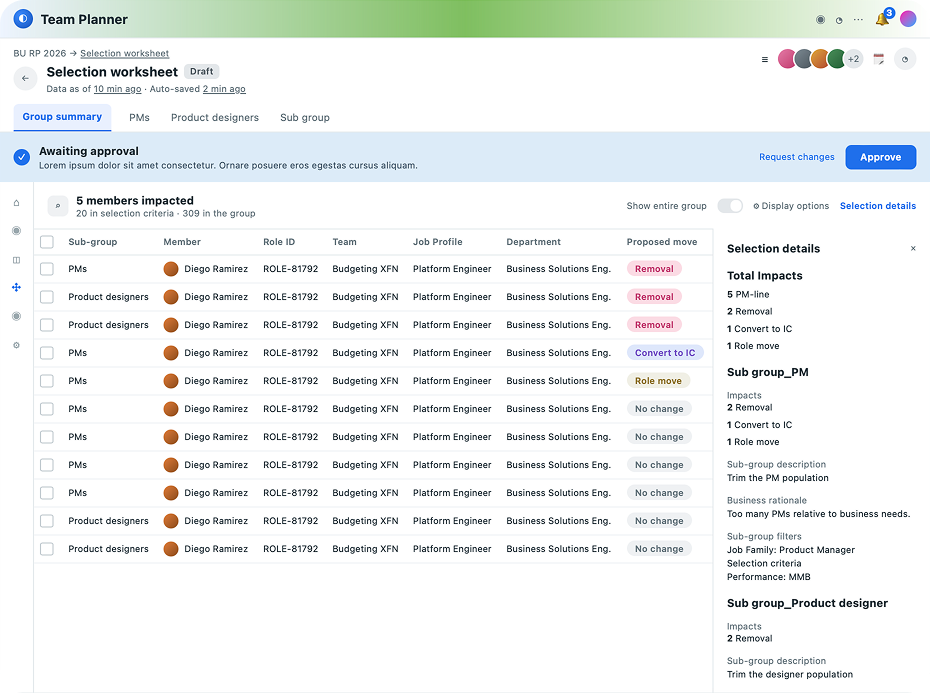
A selection worksheet awaiting approval — one of the checkbox-acknowledgement checkpoints designed so a decision-maker could double-check their own work before it moved forward.
Outcomes
- Measured: delivered in 12 weeks — an extremely fast turnaround for a project of this size — ahead of a January 2025 pilot launch
- Qualitative: peer feedback ahead of the pilot noted improved confidence and ease of completion for key personas, reduced misalignments and inaccurately defined decisional units, and reduced perceived legal risk — all attributed directly to the UI content and notification strategy
- Downstream: this project set the infrastructure for how sensitive reorgs are handled going forward — infrastructure that was preserved even after the tool itself was absorbed into the larger planning product
What this taught me
Identifying the failure modes in every node of a process at the very start pays dividends later. It’s easier to get everyone — legal, HRBPs, decision-makers across regions — to agree on what can go wrong than to agree on what’s right. But once you have that shared list of failure modes, you have the basic framework you can apply to every UX moment that follows. Agreement on risk turned out to be the fastest path to agreement on design.